

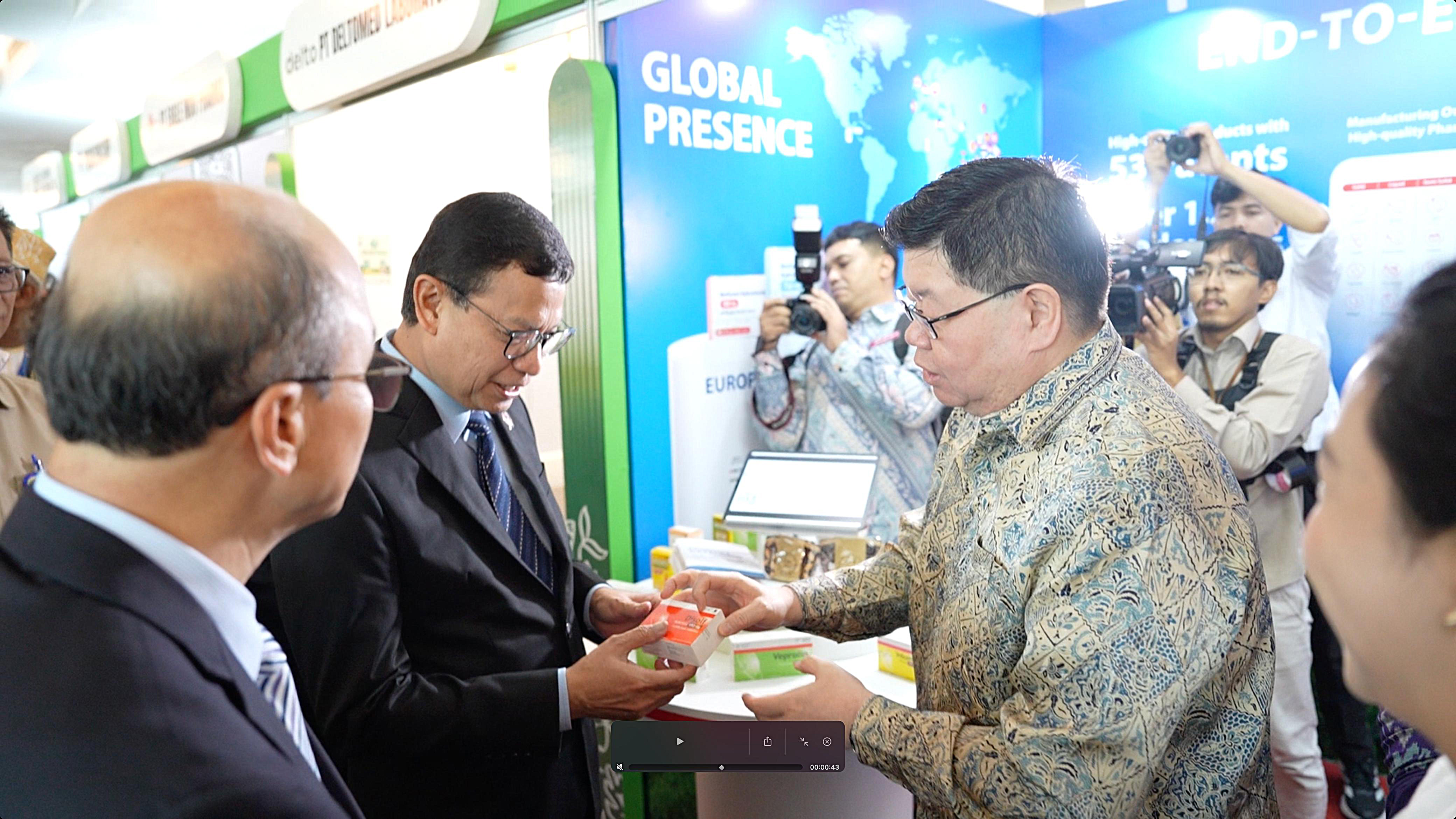
Dexa Medica once again demonstrates its strong commitment as a national pharmaceutical company that plays a vital role in strengthening Indonesia’s pharmaceutical independence, particularly through the development of natural-based medicines. This commitment was reflected in its active contribution to the prestigious 16th Annual Meeting of the WHO–International Regulatory Cooperation for Herbal Medicines (IRCH), held at JS Luwansa Hotel and Convention Center, Jakarta, on Tuesday, October 14, 2025.
Together with Indonesia’s National Agency of Drug and Food Control (BPOM RI), Dexa Medica participated in the forum attended by 58 representatives from 24 WHO–IRCH member countries. The WHO–IRCH is an international collaborative network under the coordination of the World Health Organization (WHO) that focuses on strengthening capacity and harmonizing regulatory policies for herbal medicines. Since its establishment in 2017, the network has grown to include 49 regulatory authorities from six WHO regions, including three regional/subregional bodies.
The Head of BPOM RI, Prof. Taruna Ikrar, emphasized that Indonesia possesses extraordinary natural wealth with great potential for developing natural-based medicines. “There are at least 30,000 plant species with potential for pharmaceutical use. Of these, 18,000 herbal products have been registered, including 71 standardized herbal medicines and 20 phytopharmaceuticals,” he stated. This highlights the vast opportunities for further utilization and development of natural-based medicines.
Prof. Taruna Ikrar also mentioned that, beyond natural resources, Indonesia has numerous universities and industries capable of collaborating in the research and development of natural-based medicines. “This academic–business–government collaboration is the concept I wish to promote in this IRCH meeting,” he added.
The BPOM Head expressed optimism that such collaboration will position Indonesia as a global reference for natural-based medicine development. Furthermore, it will gradually reduce Indonesia’s dependence on imported pharmaceutical raw materials.
Meanwhile, IRCH Chair Mr. Sungchol Kim, in his remarks, highlighted the core objectives of the WHO Global Traditional Medicine Strategy 2025–2034, particularly the importance of building a strong evidence base for traditional, complementary, and integrative medicine (TCIM) and developing appropriate regulations to ensure safety and efficacy. He encouraged all participants to engage actively, share knowledge and experiences in the field of herbal medicine, and ensure that the meeting delivers tangible benefits for society.
From Natural Wealth to Pharmaceutical Independence
In an interview session, Prof. Raymond Tjandrawinata, Director of Business Development and Scientific Affairs at PT Dexa Medica, emphasized the importance of mastering local raw material research as the foundation of national pharmaceutical independence.
“Indonesia ranks second in the world after Brazil in terms of biodiversity, with around 20,000 to 30,000 medicinal plant species. However, currently only 20 phytopharmaceuticals and about 70 standardized herbal medicines are registered. Through biomolecular research at Dexa Laboratories of Biomolecular Sciences (DLBS), Dexa Medica is committed to transforming Indonesia’s natural wealth into globally standardized Modern Indonesian Natural Medicines (OMAI),” said Prof. Raymond.
This statement aligns with the view of BPOM RI Head Prof. Taruna Ikrar, who believes that Indonesia has great potential to become a global reference in the development of natural-based medicines.
Dexa Medica’s contribution to pharmaceutical independence extends beyond the laboratory—realized through the downstreaming of research into tangible products. The OMAI products developed by DLBS and manufactured at PT Ferron Par Pharmaceuticals and PT Dexa Medica are the result of extensive research on Indonesia’s natural ingredients, producing certified herbal medicines, standardized herbal products, and phytopharmaceuticals.
As part of the Indonesia Herbal Mini Expo 2025, held alongside the WHO–IRCH forum, Dexa Medica showcased a wide range of research outcomes and OMAI products through a “Green Pharmacy” exhibition booth. The booth attracted significant attention from international participants and was personally visited by BPOM RI Head Prof. Taruna Ikrar and IRCH Chair Mr. Sungchol Kim.
Dexa Medica’s participation in the 16th WHO–IRCH Annual Meeting stands as clear evidence of the company’s role as a strategic government partner in building a globally competitive national pharmaceutical industry. Guided by its spirit of “Expertise for the Promotion of Health,” Dexa Medica continues to transform Indonesia’s natural wealth into sustainable health solutions for the people of Indonesia and the world.