

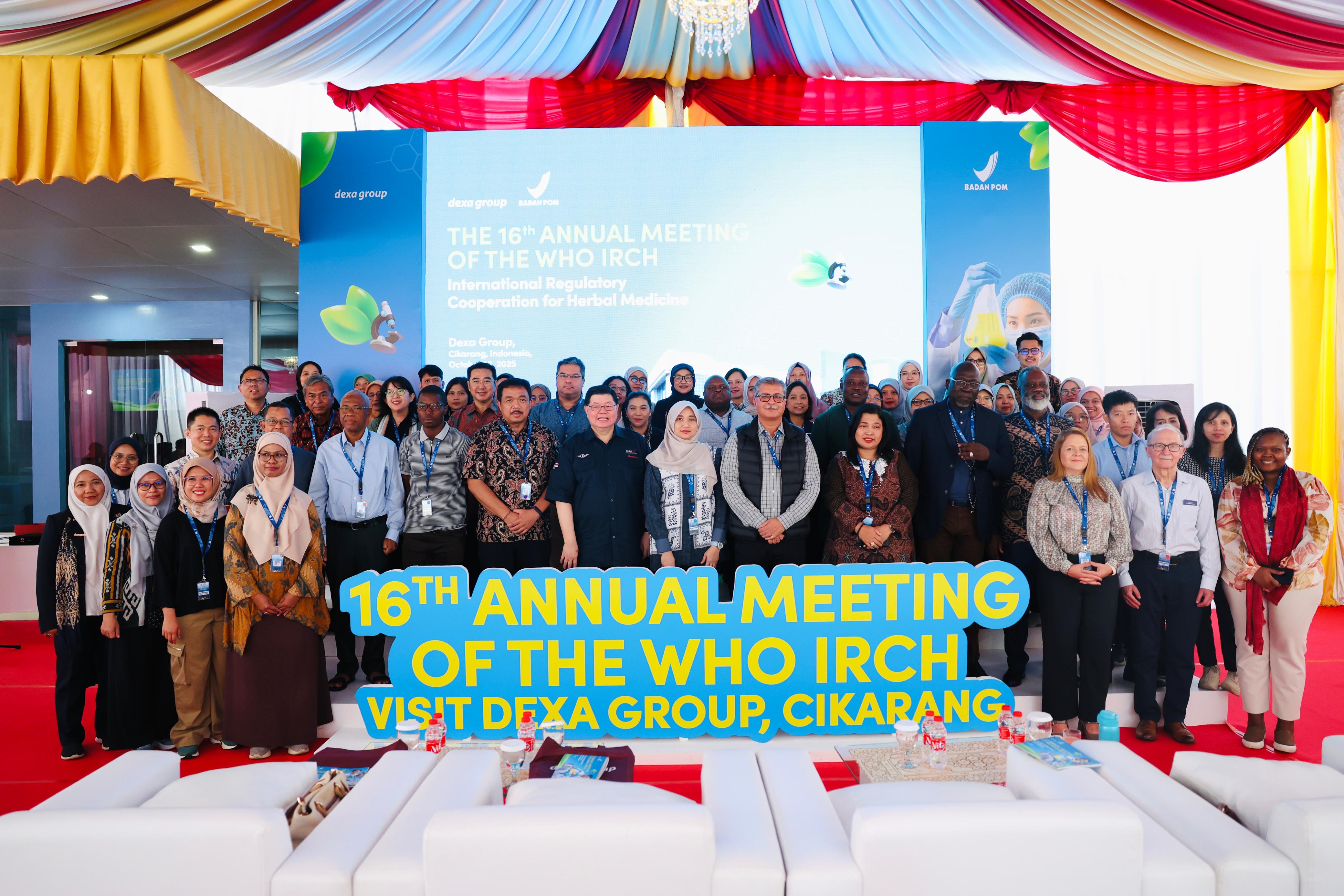
Cikarang, October 16th, 2025 – A delegation from the World Health Organization (WHO) and Indonesia’s National Agency for Drug and Food Control (BPOM RI) visited Dexa Laboratories of Biomolecular Sciences (DLBS) to observe firsthand how Indonesia’s biodiversity is being utilized in pharmaceutical research for the development of Modern Indonesian Natural Medicine (OMAI).
Prof. Raymond Tjandrawinata, Director of Business Development and Scientific Affairs at PT Dexa Medica, shared the journey of DLBS in developing natural-based medicines since 2005. The raw materials used come not only from plants but also from animals, such as Disolf, a product derived from the earthworm (Lumbricus rubellus), which helps improve blood circulation.
“Many neurologists and cardiologists have prescribed our products, as most of the phytopharmaceuticals here are doctor-prescribed. These products are not only used in Indonesia but are also exported to several ASEAN countries and beyond,” explained Prof. Raymond during the visit at the DLBS Research Center in Cikarang, West Java, on Thursday (October 16, 2025).
DLBS integrates Industry 4.0 technologies across all stages of research and product development—from the discovery of active compounds using the Tandem Chemistry Bioassay System (T-CEBS) to post-production quality monitoring. The development process of OMAI products is highly scientific, allowing their efficacy to be clinically proven.
“When we move into the clinical trial phase, scientific evidence is essential. With the right research design from the active ingredients to the finished product, herbal medicines based on biodiversity can achieve the same quality as chemical-based products,” he added.
Despite these advancements, challenges remain in the development of natural medicines, one of which is the exclusion of such medicines from Indonesia’s National Health Insurance (JKN) formulary due to regulatory constraints in Minister of Health Regulation No. 54 of 2018. Prof. Raymond noted that in countries like India, Ayurvedic and Unani medicines are already integrated into their national health systems. “In India, China, Korea, and Japan, there are hospitals dedicated to traditional medicine. Indonesia, with the world’s second-largest biodiversity, has yet to reach that point,” said Prof. Raymond.
A Global Example of Natural Medicine Development
Dian Putri Anggraweni, Director of Traditional Medicine, Health Supplement, and Cosmetic Standardization at BPOM RI, stated that DLBS’s innovations exemplify how Indonesia’s natural medicines can evolve into world-class products. This aligns with the government’s policy to strengthen the national research and development ecosystem for natural medicines and phytopharmaceuticals.
“Dexa Medica is one of Indonesia’s leading pharmaceutical industries. The company has made remarkable progress in developing herbal medicines. We can learn from Dexa Medica’s best practices on how herbal medicines can become globally recognized products,” said Dian Putri.
As highlighted on the BPOM website, WHO-IRCH Secretariat Dr. Pradeep Kumar Dua recently introduced the WHO Global Traditional Medicine Strategy 2025–2034, emphasizing that one of its four main objectives focuses on regulatory development. “The regulations address not only products but also the practices and practitioners of traditional, complementary, and integrative medicine,” he explained. The visit provided an opportunity to strengthen the global regulatory framework for natural medicines.
IRCH Chair Sungchol Kim, in his address at the 16th Annual Meeting of the WHO–International Regulatory Cooperation for Herbal Medicines (IRCH) on October 14, 2025, underscored the importance of building a strong evidence base for traditional, complementary, and integrative medicine (TCIM) and developing sound regulations to ensure safety and efficacy. He encouraged all participants to engage actively, exchange insights, and share experiences to advance the field of herbal medicine for the benefit of global health.
During the visit, the delegation toured DLBS’s biotechnology laboratories, natural extract facilities, and OMAI development areas, engaging directly with DLBS researchers about their innovation processes.
This visit also marked an important step in strengthening collaboration among government, industry, and international institutions. Such cross-sector partnerships are expected to position Indonesia as a global hub for tropical pharmaceutical biodiversity research.
Dr. Pradeep Kumar Dua emphasized the importance of developing phytopharmaceuticals that meet international standards. WHO recognizes Dexa Medica’s biodiversity-based pharmaceutical innovation as aligned with its global strategy for complementary and integrative medicine.
“I see that Dexa integrates innovation and biodiversity in the development of phytopharmaceutical products,” said Dr. Pradeep.
“This initiative represents a strong collaboration between regulators and industry players. We hope to see more cross-sectoral partnerships among various stakeholders and governments across member countries,” Dr. Pradeep concluded.