

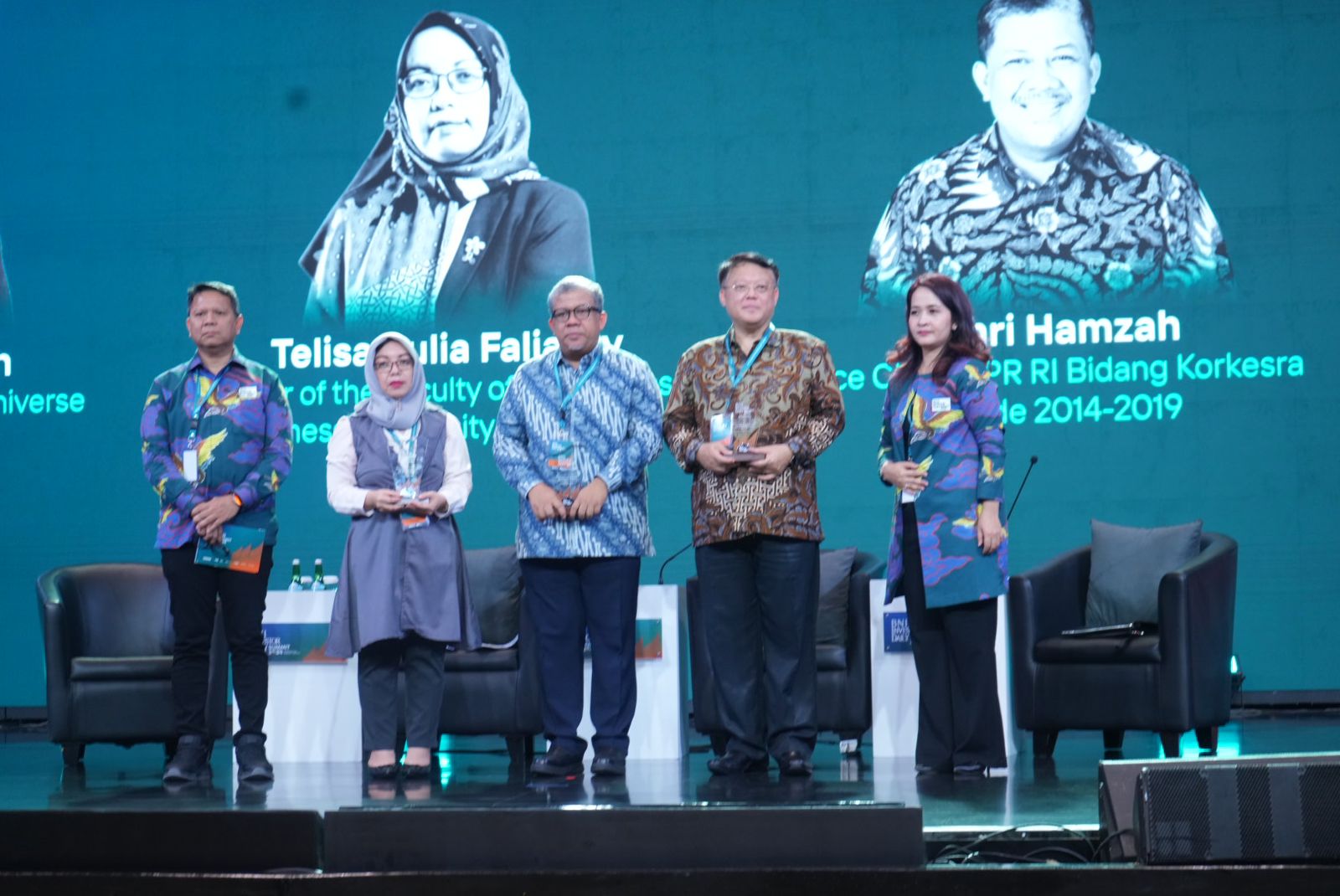
Collaboration between the government, State-Owned Enterprises (SOEs), and the private sector in the health sector plays a crucial role in building a stronger and more equitable national health system and economy.
This was the conclusion drawn by speakers at the BNI Investor Daily Summit 2024 during Plenary Session 4, titled “Balancing Act: How Indonesia’s Economy Must Maximize SOEs & The Private Sector,” held at the Plenary Hall of JCC Senayan on Wednesday, October 9, 2024.
The speakers included the President Director of PT Medela Potentia, Mr. Krestijanto Pandji, Professor of Economics from the University of Indonesia, Prof. Telisa Aulia Falianty, former Deputy Speaker of the House of Representatives (2014-2019), Mr. Fahri Hamzah, with the session moderated by B-Universe’s President Director, Mr. Rio Abdurrahman.
Prof. Telisa Aulia Falianty emphasized that the roles of SOEs and the private sector are equally important in building Indonesia’s economy, particularly in the healthcare sector.
“There are several sectors with high potential for collaboration, including digitalization, renewable energy, infrastructure, agriculture, and healthcare,” said Prof. Telisa.
This synergy could strengthen healthcare infrastructure, accelerate access to high-quality health products and services, and create opportunities for exploring global markets.
“The experience of Dexa Group in exporting medicines to Europe was also supported by the Ministry of Foreign Affairs in finding partners. This kind of collaboration is highly significant,” said Mr. Krestijanto Pandji, President and Director of PT Medela Potentia.
Collaboration can be carried out by producing pharmaceutical raw materials domestically, expanding the use of medicines derived from Indonesia’s biodiversity, and manufacturing medical devices within the country. This aligns with President Joko Widodo’s directives to promote independence in the domestic pharmaceutical and medical device industries.
“Herbal medicines are, in fact, the result of tripartite cooperation between the government, SOEs, the private sector, and Micro, Small, and Medium Enterprises (MSMEs),” explained Mr. Krestijanto Pandji.
A concrete example of this tripartite collaboration is the production of herbal medicines. The private sector obtains raw materials from farmers, while the government benefits from tax revenues.
For example, the extract of the Meniran plant is sourced from MSMEs and processed domestically. This extract is used in herbal medicines that are widely consumed in Indonesia and exported abroad.
“These herbal medicines were widely used during the COVID-19 pandemic and were even exported to countries like the Philippines,” added Mr. Krestijanto.
Unlike the pharmaceutical industry, which produces 90% of its products domestically, most medical devices used in Indonesia are still imported. According to data from the Central Statistics Agency (BPS), Indonesia imported medical devices worth US$1.48 billion in 2022.
To overcome this issue, continuous innovation, research, and development must require substantial long-term investment and collaboration between the government, SOEs, and the private sector.
“It is crucial to enhance collaboration between SOEs and the private sector to increase investment in medical devices,” emphasized Mr. Krestijanto.
PT Medela Potentia, through its subsidiary PT Deca Metric Medica (DMM), is also developing the medical device industry. DMM manufactures sterile and non-sterile wound dressings and surgical supplies. The Indonesian Minister of Health, Mr. Budi Gunadi Sadikin, inaugurated the DMM medical device facility at the Jababeka Industrial Estate on December 21, 2023.